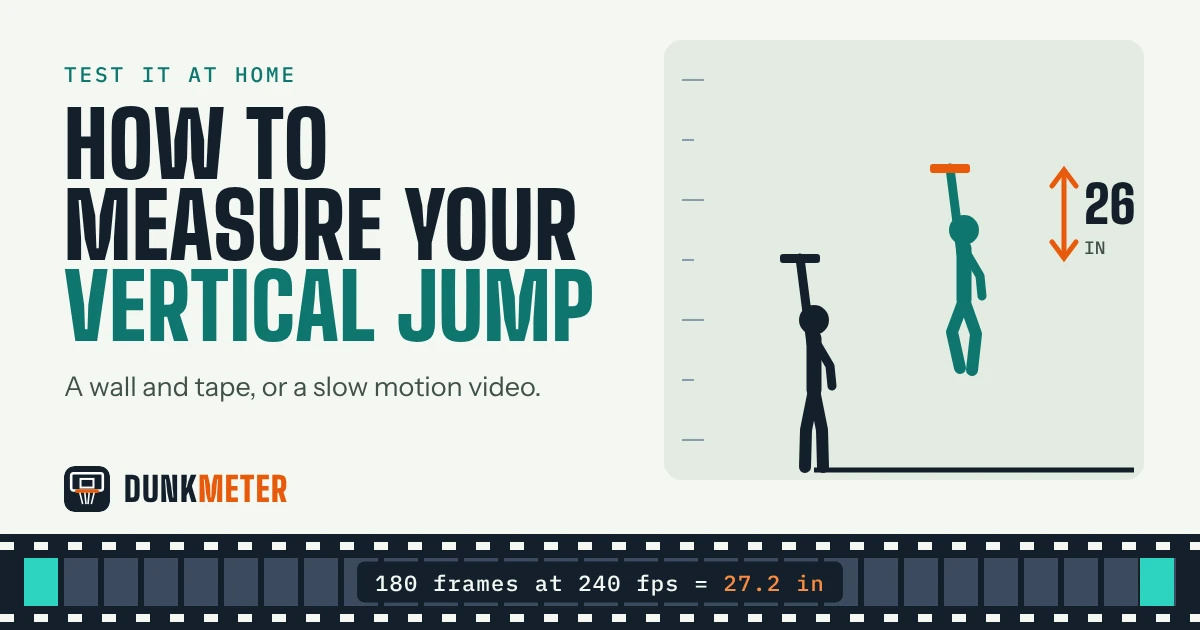
To measure your vertical jump, mark your standing reach on a wall. Then jump and mark the highest point you touch. The gap between the two marks is your vertical jump.
No tall wall? Film the jump in slow motion and count the frames you spend in the air. The jump timer below turns those frames into inches.
Since 2000, about half of all NBA draft prospects jumped 29 inches or more with no step. With a run up, about half reached 34.5 inches.
29.0 inMiddle NBA combine jump with no step
34.5 inMiddle NBA combine jump with a run up
+5.37 inWhat a run up added on average
0.3 inError from one video frame at 240 fps
Already tested? Put your wall marks or your frame count in here.
Turn your jump test into inches
| Frames in the air at 240 fps | Air time | Jump height |
|---|---|---|
| 120 | 0.500 s | 12.1 in (30.7 cm) |
| 140 | 0.583 s | 16.4 in (41.7 cm) |
| 160 | 0.667 s | 21.5 in (54.5 cm) |
| 170 | 0.708 s | 24.2 in (61.5 cm) |
| 180 | 0.750 s | 27.2 in (69.0 cm) |
| 200 | 0.833 s | 33.5 in (85.2 cm) |
| 220 | 0.917 s | 40.6 in (103.0 cm) |
Video math: height in meters = 1.22625 × air time in seconds, squared. Combine jumps: NBA.com Draft Combine stats, 2000 to 2026.
Pick a test that fits your space
The wall and tape test
- Find a wall taller than your best jump, with flat floor in front of it.
- Rub chalk on your middle fingertip, or stick a small piece of tape on it.
- Stand side on to the wall with your feet flat. Reach straight up with the arm nearest the wall and touch as high as you can. This mark is your standing reach.
- Jump off both feet with no step. Touch the wall at the top of your jump.
- Rest, then jump twice more and keep your best mark.
- Measure from the floor to each mark. Take your reach mark away from your jump mark.
Say your reach mark sits at 7 ft 10 in, which is 94 inches.
Your best jump mark sits at 10 ft, which is 120 inches. 120 minus 94 is 26, so your vertical jump is 26 inches.
The NBA Draft Combine runs two jumps like this: a no step vertical jump and a maximum vertical jump. The maximum jump comes with a run up.
The phone video test
- Turn on slow motion in your phone camera. Pick the highest frames per second it offers.
- Set the phone on the floor or a low shelf, side on, so it sees your feet and the floor.
- Put your hands on your hips, or swing your arms the same way on every jump.
- Jump straight up. Land with your legs straight, the way you took off.
- Play the video frame by frame. Find the last frame with your toes on the floor and the first frame with them back down. Count the frames from one to the other.
- Put the count and the frame speed into the jump timer above.
Landing matters. If you bend your knees or ankles just before you land, you stay in the air longer on the video. Then the jump reads too high. One foot landing before the other throws the count off too.
A review of 21 studies in Scientific Reports (2023) names both traps. It looked at a phone app that times jumps from slow motion video.
The review found no significant difference between the app and lab equipment. When the same jumps were measured twice, the results matched almost perfectly.
The math behind the timer
You rise for half your air time and fall for the other half. That gives one rule: jump height in meters equals 1.22625 times your air time in seconds, squared. The review lists the same rule.
Take 180 frames filmed at 240 frames per second. 180 divided by 240 is 0.75 seconds in the air.
0.75 times 0.75 is 0.5625. Times 1.22625, that is 0.690 meters, or 27.2 inches.
Timing jumps by air time goes back to a 1983 study by Carmelo Bosco, Pekka Luhtanen and Paavo Komi. They timed each jump with a digital timer.
Gym gear: jump mats, vanes and force plates
A jump mat times your air time, the same way the phone video does. A stand with plastic vanes that you swat at the top of your jump works like the wall test.
A force plate measures the push you put into the floor. The 2023 review says force plates are often seen as the gold standard. It also says their cost keeps them out of most field tests.
No step or run up: which number should you log?
Log both, and write down which is which. A run up jump is almost always the bigger number.
In NBA.com Draft Combine stats, a run up added 5.37 inches on average. That covers 1,615 prospects who did both jumps from 2000 to 2026.
The DunkMeter calculator asks for your no step jump, then adds your run up on top. If you only measured a run up jump, pick “With a run up” in the jump timer. It takes the run up off before it sends your number to the calculator.
Why your wall and phone numbers will not match
The wall test measures how much higher your fingertips go than your standing reach. The video measures how long your whole body stays in the air.
Those are two different things, so one jump can give two numbers. Pick one test and use it every time, with the same shoes and the same warm up.
On video, the frame speed sets your error. Here is what one missed frame does to a 24 inch jump:
| Frame speed | One frame lasts | One frame off moves the jump by |
|---|---|---|
| 30 fps | 0.033 s | about 2.3 in |
| 60 fps | 0.017 s | about 1.1 in |
| 120 fps | 0.008 s | about 0.6 in |
| 240 fps | 0.004 s | about 0.3 in |
A 24 inch jump stays in the air about 0.705 seconds. At 30 fps that is only about 21 frames, so each frame counts for a lot.
How does your number compare?
NBA prospects rank among the best jumpers in the world, so read this table as the top end.
| Your jump | NBA prospects at or above it, no step | NBA prospects at or above it, with a run up |
|---|---|---|
| 24 in | 96.4% | 99.9% |
| 26 in | 87.9% | 99.5% |
| 28 in | 68.3% | 97.2% |
| 30 in | 43.2% | 91.2% |
| 32 in | 21.4% | 78.0% |
| 34 in | 7.1% | 59.0% |
| 36 in | 1.9% | 37.6% |
| 38 in | 0.5% | 20.0% |
| 40 in | 0.1% | 8.6% |
So a 30 inch jump with no step beats more than half of all NBA prospects. With a run up, 91.2% of them reached 30 inches.
The highest jumps ever measured there are on the NBA vertical jump record list.
Put your number to work
Your vertical alone does not tell you if you can dunk. Your standing reach decides where the jump starts.
Put both into the dunk calculator to see how far your hand gets above the rim. No wall for your reach? Measure your wingspan and the calculator estimates it.
Then test again every couple of weeks, the same way each time. Vertical jump training shows what a plan can add, and its jump week builder keeps a log of your tests.
Fast answers about jump tests
How do you measure your vertical jump without a wall?
Use your phone. Film the jump in slow motion from the side. Count the frames from takeoff to landing, then put the count into the jump timer. 180 frames at 240 fps works out to 27.2 inches.
Can you measure your vertical jump with your phone?
Yes. A 2023 review of 21 studies found no significant difference between a slow motion phone app and lab equipment. Land with straight legs, or the jump reads too high.
Should you swing your arms when you test?
Pick one way and keep it. A 2016 Journal of Human Kinetics paper found an arm swing added 38% to jump height in elite volleyball players. Earlier studies it cites found 15% to 24%.
How many jumps should you take?
Warm up first, then take three good jumps and keep the best one. Use the same count every time you test.
Is a 30 inch vertical good?
Yes. With no step, 43.2% of NBA draft prospects since 2000 reached 30 inches. With a run up, 91.2% did.
Sources
- NBA.com Draft Combine stats, every combine from 2000 to 2026
- NBA.com, “What drills are held at NBA Draft Combine?”, 4 May 2026
- Gençoğlu and colleagues, “Validity and reliability of My Jump app to assess vertical jump performance: a meta analytic review”, Scientific Reports, 17 November 2023
- Bosco, Luhtanen and Komi, “A simple method for measurement of mechanical power in jumping”, European Journal of Applied Physiology, 1983
- Vaverka and colleagues, “Effect of an arm swing on countermovement vertical jump performance in elite volleyball players”, Journal of Human Kinetics, 14 October 2016